
Home › Cybersecurity & GRC Career Guides › Risk Assessment Skills
Risk Assessment Skills
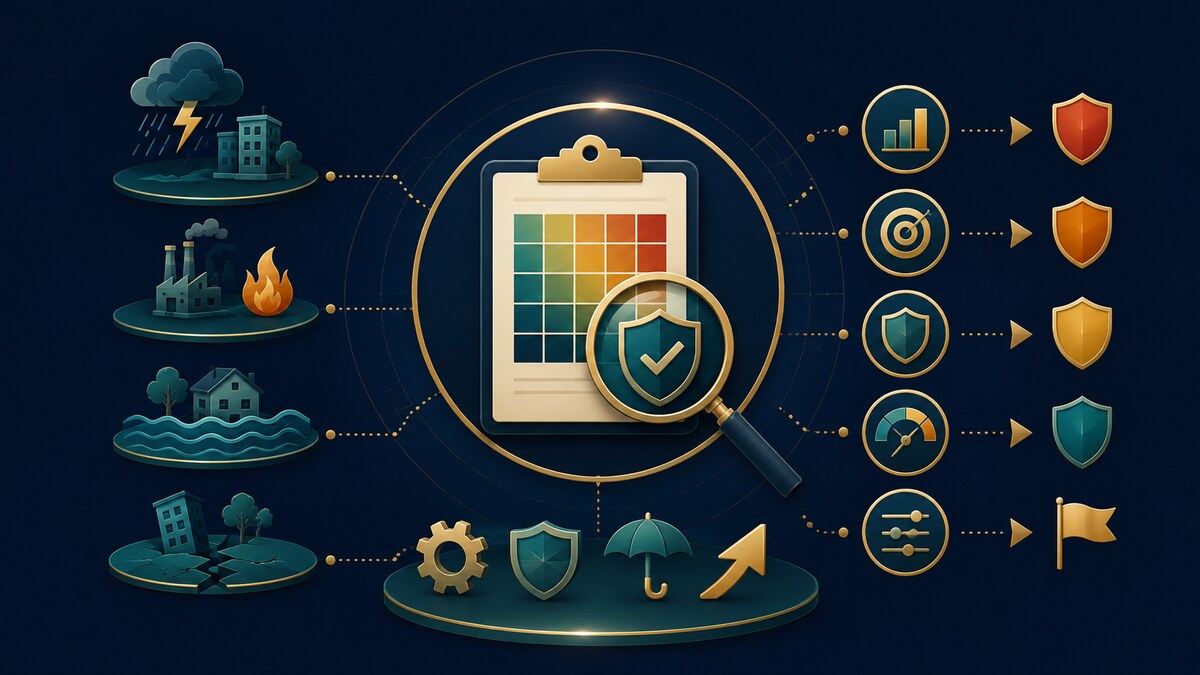
Almost every GRC posting asks for risk assessment. Very few explain that the hard part is not spotting risks. Anyone can list things that might go wrong. The hard part is scoring them so that two people working separately land in roughly the same place, and so that a decision can be made from the result.
Consistency is the actual skill
Give ten people a five by five likelihood and impact matrix with no definitions attached and you get ten different answers, because "medium" means whatever the assessor had for breakfast. The fix is defining the scale before you use it, in terms someone can check.
Impact bands should be tied to something real: a dollar figure, hours of downtime, a number of affected records, a regulatory consequence. Likelihood should be tied to observed frequency where you have it, and to a stated assumption where you do not. "Once in ten years" is arguable. "Medium" is not, because there is nothing there to argue with.
When an interviewer asks how you assess risk, this is the answer they are listening for.
Inherent, residual, and the one people skip
Inherent risk is the exposure before controls. Residual is what remains after the controls that actually operate. The word doing the work in that sentence is "actually". A control that exists on paper but has not run since the last reorganization does not reduce residual risk, and treating it as though it does is how registers drift into fiction.
The step most people skip is comparing residual risk to a stated appetite. Without that comparison, an assessment produces a number and no decision. With it, the assessment ends in one of four places: accept, mitigate, transfer, avoid. Naming which one, and who signed for it, is what turns analysis into governance.
Qualitative, quantitative, and when to switch
Most organizations run qualitative scoring, and for most risks that is proportionate. Quantitative methods, FAIR being the best known, express exposure in money and probability ranges instead of colors.
The honest guidance is that quantification is worth the effort when the decision is expensive and contested, a large cyber insurance renewal or a nine-figure remediation program. Applying it to every entry on a register of two hundred items burns a quarter and changes nothing. Knowing when not to reach for it is itself a senior skill.
Frameworks worth knowing by name
ISO 31000 gives you the vocabulary and the process. NIST SP 800-30 is the standard reference for information security risk assessment. COSO ERM connects risk to strategy and is the language finance and internal audit already speak. For AI systems, the NIST AI Risk Management Framework organizes the work around Govern, Map, Measure and Manage, and the EU AI Act sorts systems into risk tiers with obligations attached to each.
You do not need all of them. You need to know which one the room is speaking.
Keeping the register alive
A risk register that is refreshed once a year during audit season is a document, not a control. The registers that stay useful have owners on every line, review dates that arrive, and a visible history of what changed and why. The unglamorous part of this skill is chasing people, and it is most of the job.
If you want to test yourself before an interview: take one risk you can describe from your own working life, score it with defined bands, state the controls that genuinely operate, compute a residual position, and say what you would recommend and who would have to accept it. That is the whole loop in one page.
Where to go next
- Browse the jobs that use these skills
- Follow a career roadmap into the role you want
- Hiring for this? Start from a job description template
- Free certification study games, 592 practice questions
Frequently Asked Questions
What are risk assessment skills?
The ability to identify what could go wrong, score likelihood and impact against defined and defensible scales, account for the controls that genuinely operate, and turn the result into a decision to accept, mitigate, transfer or avoid. Consistency matters more than sophistication.
What is the difference between inherent and residual risk?
Inherent risk is exposure before controls. Residual risk is what remains after the controls that actually operate. Controls that exist on paper but do not run should not reduce your residual score, and treating them as though they do is a common way registers become fiction.
Should I use qualitative or quantitative risk assessment?
Qualitative scoring is proportionate for most risks. Quantitative methods such as FAIR are worth the effort when a decision is expensive and contested, for example a large insurance renewal or a major remediation program. Applying quantification to every line of a two hundred item register consumes a quarter and rarely changes an outcome.
What frameworks cover risk assessment?
ISO 31000 for vocabulary and process, NIST SP 800-30 for information security risk, and COSO ERM for the link between risk and strategy. For AI systems, the NIST AI Risk Management Framework and the risk tiers in the EU AI Act.
How do you make risk scoring consistent between assessors?
Define the scale before using it. Tie impact bands to something checkable such as a dollar figure, hours of downtime or a number of affected records, and tie likelihood to observed frequency or a stated assumption. Undefined labels like "medium" produce inconsistency by design.
What is risk appetite and why does it matter?
Risk appetite is the level of residual risk an organization has decided it will accept. Without it an assessment produces a number but no decision. With it, every assessed risk resolves to accept, mitigate, transfer or avoid, with a named person accountable for that choice.
Do risk assessment skills transfer between industries?
The method transfers well. The context does not. Loss thresholds, regulators and the risks that dominate differ sharply between a hospital, a bank and a software company, so expect to relearn the specifics even when the technique carries over.
What jobs require risk assessment skills?
Risk analyst, GRC analyst, internal auditor, compliance manager, third-party risk analyst, model risk and AI governance roles. It is one of the most portable skills in the field.
How do I demonstrate risk assessment skills in an interview?
Walk through one real risk end to end: how you scored it and why those bands, which controls genuinely operated, what the residual position was, and what you recommended. Interviewers are listening for defensible reasoning, not a memorized framework.
More in this series
- 9 Essential Data Governance Skills for the AI Era
- 10 Internal Audit Skills for Modern Assurance Careers
- 12 Transferable GRC Skills You May Already Have
- Technical vs. Nontechnical GRC Skills: What Employers Actually Need
- AI Governance Skills Employers Actually Hire For
- GRC Analyst Skills: What the Job Actually Requires
- Compliance Analyst Skills
- Controls Testing Skills
- Policy Writing Skills
- Regulatory Change Management Skills
- Third-Party Risk Skills
- Model Risk Management Skills
- AI Impact Assessment Skills
- AI Auditing Skills
- AI Evaluation and Testing Skills for Governance Careers
- Data Lineage Skills
- Data Quality Skills
- Privacy Engineering Skills
- AI Security Skills
- AI Incident Response Skills
- Governance Program Management Skills
- Stakeholder Communication Skills
- Executive Risk Reporting Skills
- Evidence Documentation Skills
- Control Mapping Skills
- Framework Crosswalking Skills
- Vendor Due Diligence Skills
- Responsible AI Skills
- GRC Tools and Automation Skills
- How to Build the 9 Data Governance Skills: A 12-Month Career Plan
- Founder of ExecSearches and GRC Careers
- Executive search across corporate, higher education, financial services, and nonprofit sectors
- Focus on AI governance and GRC hiring
- More than a decade in risk advisory and internal audit in financial services
- Led SOX and regulatory audits for Citi, Goldman Sachs, Morgan Stanley, and McKesson
- Public Accounting Certification, Cornell University