
Home › Cybersecurity & GRC Career Guides › GRC Analyst Skills: What the Job Actually Requires
GRC Analyst Skills: What the Job Actually Requires
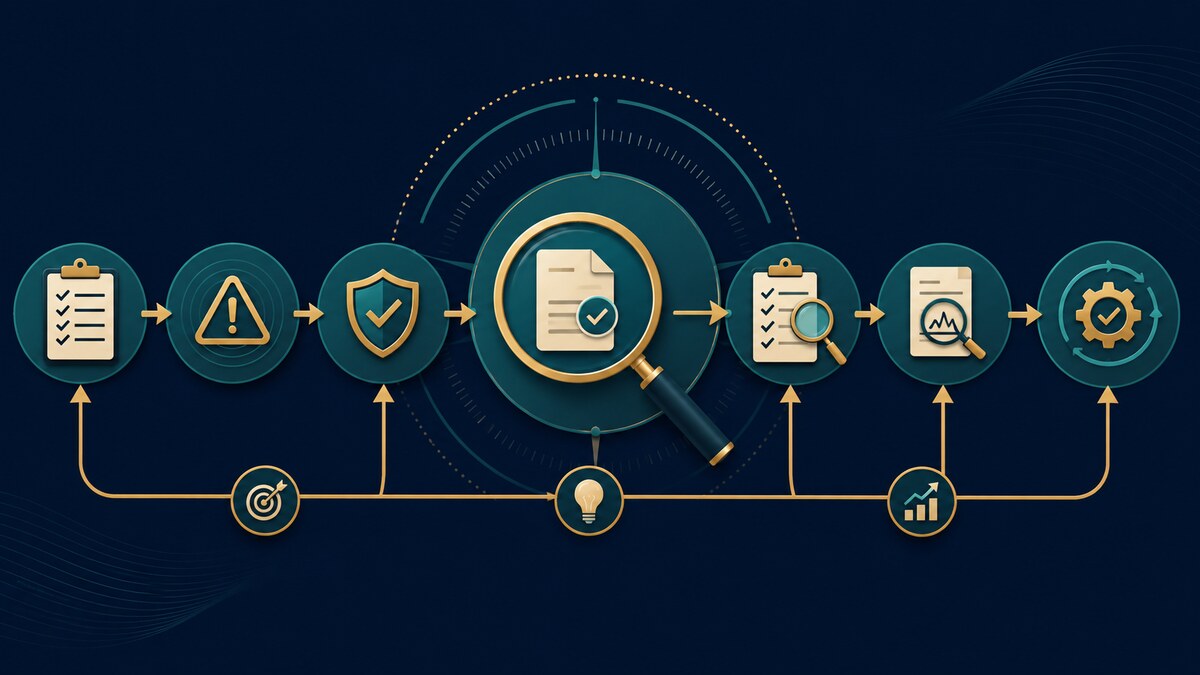
GRC analyst postings read like a list of nouns: risk, controls, compliance, frameworks, evidence. That tells you what the job touches but nothing about what you would do on a Tuesday morning.
What you would actually do is run a loop. A requirement arrives, gets mapped to a control, the control gets an owner and a test date, the test produces evidence and findings, the findings get closed on a clock, and the whole thing gets reported upward. Then something changes and it runs again. Every skill below exists to keep that loop moving.
Key takeaways
- Employers weight technical and business skills roughly evenly. Career changers usually underestimate how much of the second half they already have.
- The differentiating technical skill is control mapping: making one test satisfy several frameworks at once.
- The differentiating business skill is getting evidence out of people who see you as overhead.
- Most of the job is chasing, testing, documenting and translating. Very little of it is reading regulations.
The technical half
Risk assessment and risk register management. Identifying what could go wrong, scoring it consistently enough that two analysts would reach similar answers, and keeping the register current rather than letting it calcify into a spreadsheet nobody opens.
Control design, mapping and testing. Mapping is where the leverage is. ISO 27001 A.9.2.3, SOC 2 CC6.1 and your internal access policy are frequently asking one company to do one thing. An analyst who can see that runs one test instead of three.
Evidence collection and validation. Not just gathering screenshots, but checking dates, checking completeness, and checking whether a sample covers the whole population or only the convenient part of it.
Compliance monitoring and audit readiness. The difference between a good and a bad program is whether evidence accumulates continuously or gets reconstructed in a panic three weeks before fieldwork.
Policy and standards management, issue and remediation tracking, third-party risk, regulatory interpretation. Plus enough cybersecurity, privacy and cloud fundamentals to argue with an engineer about whether a control is really operating.
The business half
Technical writing. In GRC the document is the control. A control description nobody can follow is a control that does not operate, whatever the register says.
Interviewing control owners. There is a real technique to asking someone how they do something without putting them on the defensive, and to noticing when the answer describes the policy rather than the practice.
Stakeholder management. You will spend a lot of time asking busy people for things that do not help them hit their own targets. Doing that without becoming an irritant is a skill.
Prioritization and executive communication. Turning forty open findings into the three an executive needs to decide about, without hiding the other thirty-seven.
What a GRC analyst does each day
Drawn from what GRC analyst postings actually describe: review overdue remediation items and overnight changes to the risk register. Meet IT or security about evidence for an access-control assessment, where half the conversation is explaining why last quarter's screenshot will not do again. Review a new vendor's security questionnaire and decide what to escalate. Map a set of framework requirements against existing controls and flag the genuine gaps. Test documentation a control owner supplied, and send half of it back. Update findings in the platform. Draft the reporting that goes to management.
Where automation is changing the job
Tooling is absorbing the collection half of the work: evidence gathering, control mapping, regulatory change monitoring, questionnaire responses, continuous control monitoring. It is not touching the judgment half. No tool decides whether a piece of evidence is valid, whether a control genuinely addresses its risk, whether an exception matters, or what the organization should do about it.
That is the whole argument for this career. The clerical part is being automated and the judgment part is being hired for, which is why GRC tools and automation skills have become the fastest-appreciating thing on a GRC résumé.
How to prove these skills
Take one framework and one system you actually understand. Build the control matrix: clauses mapped to testable controls, each with an owner, a test procedure, an evidence requirement, and one worked sample test result showing what pass and fail look like.
That artifact demonstrates mapping, testing, evidence discipline and writing in a single document. If you are studying alongside it, the 592 free certification practice questions cover CISA, CISM, CRISC and the AIGP.
For the full picture of the role, read the how to become a GRC analyst roadmap.
Where to go next
- Browse the jobs that use these skills
- Follow a career roadmap into the role you want
- Hiring for this? Start from a job description template
- Free certification study games, 592 practice questions
Frequently Asked Questions
What skills do GRC analyst jobs require?
Two stacks, weighted about evenly. Technical: risk assessment, control design, control mapping, control testing, evidence collection, compliance monitoring, audit readiness, policy management, remediation tracking, third-party risk, and cybersecurity and privacy fundamentals. Business: technical writing, documentation, interviewing control owners, stakeholder management, prioritization, and executive communication.
Do you need to code to be a GRC analyst?
No. GRC is one of the few paths adjacent to cybersecurity that does not require coding. SQL and basic scripting help with evidence automation and analysis, and they are becoming more common in postings, but they are rarely a hard requirement at analyst level.
What is control mapping and why does it matter so much?
It is recognizing when several frameworks are asking for the same thing. ISO 27001, SOC 2 and an internal policy often want one control to exist. An analyst who maps well runs one test that satisfies all three, which is the difference between a program that scales and one that drowns every audit cycle.
What does a GRC analyst do all day?
Mostly chasing, testing, documenting and translating. Reviewing overdue remediation, collecting and validating evidence from control owners, reviewing vendor questionnaires, mapping requirements to existing controls, testing what owners supply, updating findings, and preparing management reporting. Very little of the day is spent reading regulations.
Is GRC part of cybersecurity?
It is the governance and assurance layer around cybersecurity, and usually sits in the same reporting line. A security engineer configures a control; the GRC analyst determines which framework requires it, verifies it covers everything in scope, reviews the evidence that it operates, and tracks the exceptions.
Which certifications help a GRC analyst?
CISA is the most recognized for the audit and testing side, CRISC for risk, CGRC for the governance track, and the AIGP if you are moving toward AI governance. Treat them as supporting evidence. A control matrix you built and can explain will do more in an interview than the certificate on its own.
Will AI replace GRC analysts?
It is taking the collection half of the work, not the judgment half. Automation now handles evidence gathering, control mapping suggestions, regulatory change monitoring and continuous control monitoring. Deciding whether evidence is valid, whether a control addresses its risk, and whether an exception matters remains human, and those are the parts employers are hiring for.
How do I get a GRC analyst job with no experience?
Come in sideways from audit, IT operations, compliance, project management or a help-desk security role, and bring an artifact. Build a control matrix for one framework against a system you know, with owners, test procedures, evidence requirements and a worked sample result. That plus a relevant certification is a stronger application than either alone.
More in this series
- 9 Essential Data Governance Skills for the AI Era
- 10 Internal Audit Skills for Modern Assurance Careers
- 12 Transferable GRC Skills You May Already Have
- Technical vs. Nontechnical GRC Skills: What Employers Actually Need
- AI Governance Skills Employers Actually Hire For
- Compliance Analyst Skills
- Risk Assessment Skills
- Controls Testing Skills
- Policy Writing Skills
- Regulatory Change Management Skills
- Third-Party Risk Skills
- Model Risk Management Skills
- AI Impact Assessment Skills
- AI Auditing Skills
- AI Evaluation and Testing Skills for Governance Careers
- Data Lineage Skills
- Data Quality Skills
- Privacy Engineering Skills
- AI Security Skills
- AI Incident Response Skills
- Governance Program Management Skills
- Stakeholder Communication Skills
- Executive Risk Reporting Skills
- Evidence Documentation Skills
- Control Mapping Skills
- Framework Crosswalking Skills
- Vendor Due Diligence Skills
- Responsible AI Skills
- GRC Tools and Automation Skills
- How to Build the 9 Data Governance Skills: A 12-Month Career Plan
- Founder of ExecSearches and GRC Careers
- Executive search across corporate, higher education, financial services, and nonprofit sectors
- Focus on AI governance and GRC hiring
- More than a decade in risk advisory and internal audit in financial services
- Led SOX and regulatory audits for Citi, Goldman Sachs, Morgan Stanley, and McKesson
- Public Accounting Certification, Cornell University