
Home › AI Governance Insights › The EU AI Act, Explained: Risk Tiers, Obligations, and the Current Timeline
The EU AI Act, Explained: Risk Tiers, Obligations, and the Current Timeline
By F. Jay Hall and Stephan Pochet, Frameworks & Regulation · August 15, 2026 · Updated November 7, 2026 · 12 min read
Updated October 24, 2026
The first harmonized standard under the EU AI Act now exists. EN 18286:2026 was cited in the Official Journal on October 14, 2026. It covers the quality management system in Article 17, not the whole law. This guide now explains what it does and does not establish, and the comparison with NIST AI RMF and ISO/IEC 42001 has been tightened. What EN 18286 changes.
Key Takeaways
- The EU AI Act (Regulation (EU) 2024/1689) is the world's first comprehensive law governing artificial intelligence. It regulates AI by risk, not by technology.
- The familiar four-tier model (prohibited, high-risk, transparency, minimal risk) is a useful teaching shorthand. The Act itself applies more detailed rules: prohibited practices, high-risk classification tests and exceptions, specific transparency duties, and separate obligations for general-purpose AI models. What applies depends on the system, the actor and the use case.
- The Digital Omnibus on AI (Regulation (EU) 2026/1744) moved the heaviest high-risk deadlines back, but transparency duties and the prohibitions stayed live, two new prohibitions were added from December 2, 2026, and the maximum fines stayed in place, with lower caps for SMEs and, for some fines, small mid-cap companies.
- It reaches far beyond Europe. Providers placing AI on the EU market and deployers whose AI output is used in the EU are covered, wherever they are based.
- The first harmonized standard, EN 18286:2026, gives providers a presumption of conformity with the Article 17 quality management system requirements it covers, and only to the extent it covers them (Article 40(1)). It does not establish compliance with the Act as a whole.
- Compliance is built on evidence that accumulates over time: technical documentation, data governance records, logging, and post-market monitoring. It cannot be produced at the last minute.
How to read this guide
We separate five kinds of source. Binding law is cited to the law and article, with the regulated actor and date where they matter. A harmonized standard cited in the EU Official Journal gives a presumption of conformity only for the requirements it covers. A voluntary standard, such as ISO/IEC 42001, applies when an organization chooses it or a contract requires it. Nonbinding guidance, such as the NIST AI RMF, describes outcomes and suggested actions. A GRC Careers recommendation is our practical advice, not a legal rule.
Using NIST AI RMF or ISO/IEC 42001 can support governance work, but neither by itself establishes EU AI Act compliance. EU law references point to the consolidated text of the AI Act as at July 27, 2026, which includes the Digital Omnibus changes.
Listen to this guide
Prefer audio? A conversational, 23-minute walkthrough of the EU AI Act and what it means for how organizations govern AI.
Posted August 15, 2026, before the October 2026 update to this guide. For the current position, read what EN 18286 changes.
The European Union's Artificial Intelligence Act is the first broad, horizontal law written specifically to govern AI. It entered into force on August 1, 2024 as Regulation (EU) 2024/1689, and its obligations phase in over several years. For anyone building an AI governance program, it is the single most consequential piece of regulation in the field, and its influence extends well past Europe's borders.
This guide explains what the Act does, how its risk tiers work, which obligations fall on whom, when each part applies after the Digital Omnibus amendments, and how the Act sits alongside the NIST AI Risk Management Framework and ISO/IEC 42001.
A risk-based law, not a technology law
The Act does not try to define or restrict AI by how it is built. It regulates AI by what it is used for and how much harm it could cause. That single design choice explains almost everything about how the law is structured. The same underlying model can sit in a minimal-risk product in one deployment and a high-risk system in another. The obligations follow the use case and its potential impact on people, not the algorithm.
The four risk tiers
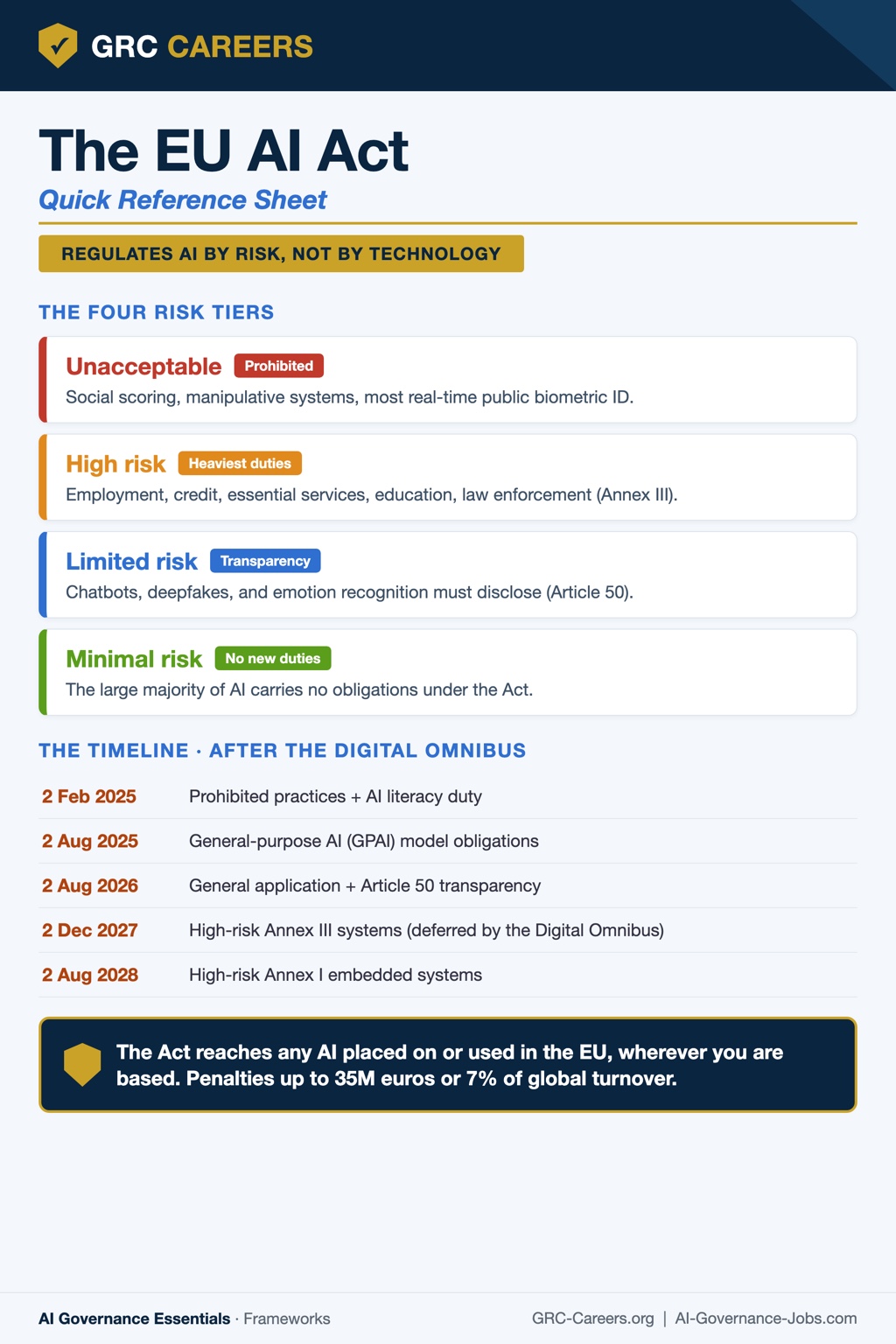
The four tiers are a teaching shorthand. The Act's legal tests sit in Article 5 (prohibited practices), Article 6 with Annex I and Annex III (high-risk classification), Article 50 (transparency) and Article 53 (general-purpose AI models). Scope comes from Article 2.
- Unacceptable risk (prohibited). A short list of practices banned outright under Article 5, including social scoring by public or private actors, certain manipulative or exploitative systems, untargeted collection of facial images from the internet or CCTV footage to build facial recognition databases, and most real-time remote biometric identification in public spaces.
- High risk. The core of the Act. Annex III lists stand-alone use cases such as AI used in employment, education, access to credit and essential services, law enforcement, migration, and the administration of justice. Annex I covers AI used as a safety component of products already regulated under EU law. High-risk systems carry the heaviest obligations. Not every Annex III system is high-risk: under Article 6(3), a system that does not pose a significant risk of harm, for example one that only performs a narrow procedural task, can fall outside the category. An Annex III system that profiles natural persons is always high-risk. A provider relying on that exception has to document its assessment before the system is placed on the market and register the system (Article 6(4) and Article 49(2)).
- Limited risk (transparency). Systems such as chatbots, emotion-recognition tools, and generators of synthetic media must tell people they are interacting with AI or that content is AI-generated, under Article 50.
- Minimal risk. Many lower-risk applications fall outside the Chapter III high-risk duties. That does not mean nothing applies. The Article 4 AI literacy duty covers providers and deployers of AI systems generally, the Article 50 transparency rules apply to the uses they list, and the GDPR or sector-specific law can apply on its own.
The application timeline after the Digital Omnibus
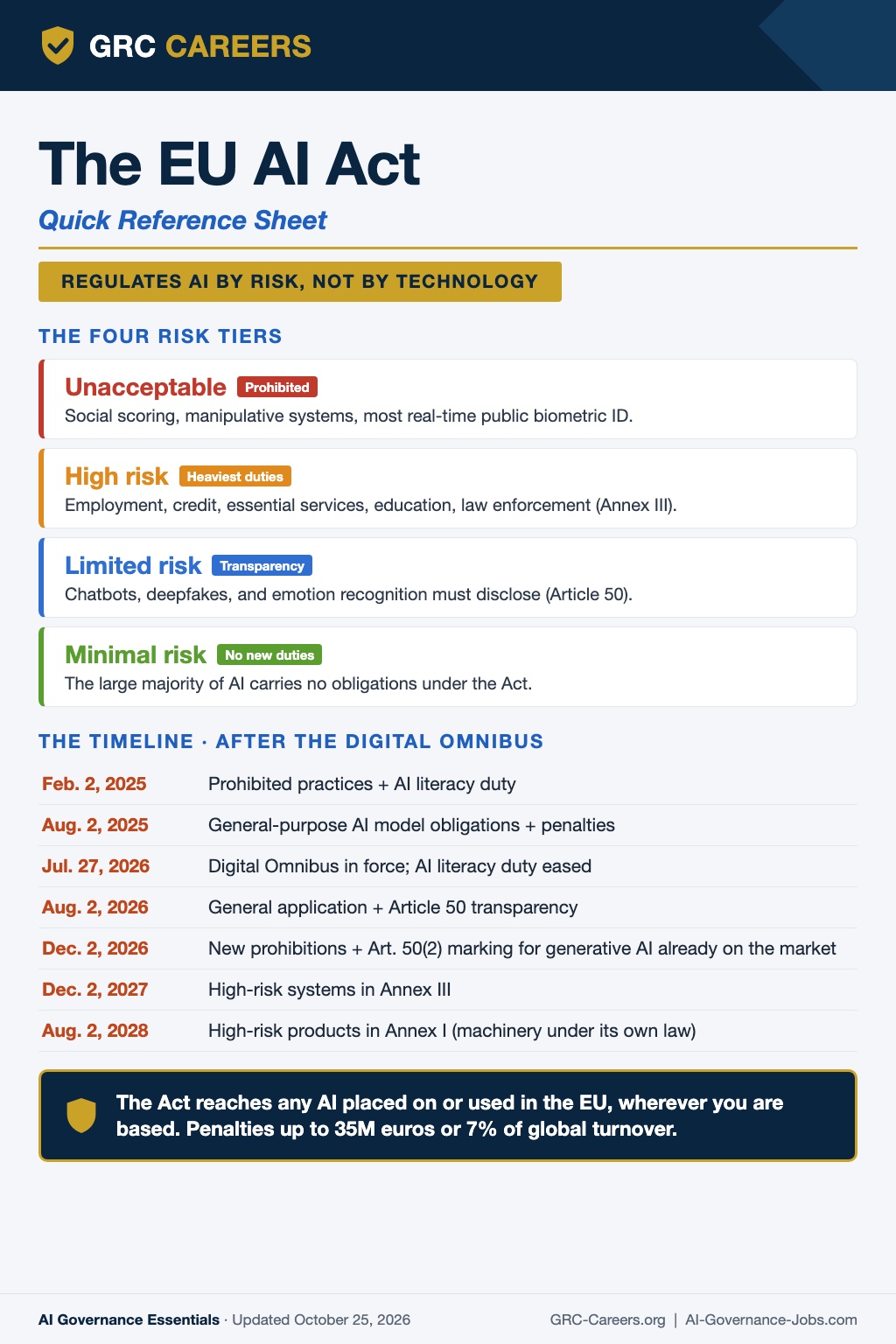
The Act applies in stages. By late 2025 the original schedule was running ahead of the standards, guidance, and national authorities needed to support it, so the Commission proposed the Digital Omnibus on AI. The resulting instrument, Regulation (EU) 2026/1744, entered into force on July 27, 2026. It moved the heaviest high-risk deadlines back, left the transparency duties and the existing prohibitions on their original timeline, and added two new prohibited practices that apply from December 2, 2026.
| Date | What applies |
|---|---|
| February 2, 2025 | Prohibited practices (Article 5), in force. The AI literacy duty (Article 4), in force but eased: since July 27, 2026 the Digital Omnibus requires providers and deployers to take measures that support AI literacy, without guaranteeing any set level. |
| August 2, 2025 | Obligations for providers of general-purpose AI (GPAI) models. |
| August 2, 2026 | General application, including the Article 50 transparency obligations. Not deferred. |
| December 2, 2026 | Two prohibitions added by the Digital Omnibus: non-consensual intimate imagery and the generation of child sexual abuse material. New, not deferred. |
| December 2, 2027 | High-risk obligations for stand-alone Annex III systems (employment, credit, essential services, and more). Deferred from August 2, 2026. |
| August 2, 2028 | High-risk obligations for AI embedded in products regulated under Annex I. Deferred from August 2, 2027. |
Do not read the delay as a reprieve. Conformity assessment for high-risk systems depends on technical documentation, data governance records, logging, and post-market monitoring evidence that has to accumulate over time. Evidence cannot be backdated. The extra months are enough to build a defensible program, and not enough to build one from nothing starting in 2027.
Who the Act applies to
The Act reaches organizations far outside the EU, an effect often called the Brussels effect. Its two most important roles are:
- Providers develop an AI system or a GPAI model and place it on the EU market or put it into service under their own name, wherever they are established. Providers of high-risk systems carry the bulk of the obligations: a risk-management system, data governance, technical documentation, logging, transparency, human oversight, accuracy and robustness, a quality management system, and conformity assessment before the system goes to market.
- Deployers use an AI system in a professional capacity. A deployer outside the EU is still covered where the output of the system is used in the EU. Deployer duties are lighter but real: use the system according to instructions, ensure human oversight, monitor operation, and in some cases run a fundamental-rights impact assessment.
General-purpose AI models
The Act sets a separate track for general-purpose AI, the large foundation models that power many downstream products. All GPAI providers owe transparency and documentation duties. Models judged to carry systemic risk face additional obligations around evaluation, risk mitigation, incident reporting, and cybersecurity. The GPAI Code of Practice gives providers a route to demonstrate compliance.
Penalties
The maximum fines are substantial, and the Digital Omnibus kept them. Breaching the Article 5 prohibitions can bring fines up to 35 million euros or 7 percent of worldwide annual turnover, whichever is higher (Article 99(3)). Breaches of the operator obligations listed in Article 99(4) carry up to 15 million euros or 3 percent. Supplying incorrect, incomplete or misleading information to notified bodies or national authorities carries up to 7.5 million euros or 1 percent (Article 99(5)).
These are ceilings, not standard amounts. For SMEs, including start-ups, each fine is capped at whichever of the two figures is lower (Article 99(6)). The Digital Omnibus added the same lower-of cap for small mid-cap companies for the Article 99(4) and (5) fines (Article 99(6a)). Authorities set the actual amount case by case, looking at the nature, gravity and duration of the breach, the operator's size and other factors (Article 99(7)).
How the Act fits with NIST and ISO/IEC 42001
The EU AI Act is law: it sets binding obligations tied to role and risk classification. It does not tell you, step by step, how to build the program that produces compliance. That is where the voluntary frameworks come in. The NIST AI Risk Management Framework gives you a risk vocabulary and process. ISO/IEC 42001 gives you a certifiable management system whose controls produce evidence the Act's obligations call for. These frameworks support governance and evidence collection. They do not establish compliance on their own: that still means checking every applicable obligation against the specific system, your organization's role as provider or deployer, and the use case. For the mapping in detail, see how the EU AI Act maps to NIST AI RMF and how ISO/IEC 42001 maps to the law.
EN 18286: what the first harmonized standard changes
On October 14, 2026, the Official Journal of the European Union published the reference to EN 18286:2026, Artificial Intelligence, Quality management system for EU AI Act regulatory purposes, through Commission Implementing Decision (EU) 2026/2274. It is the first harmonized standard in support of the Act.
A provider of a high-risk AI system that follows it gets a presumption of conformity with the Article 17 requirements the standard covers, the quality management system. That is the extent of it. It does not establish compliance with the AI Act as a whole. The technical requirements the system itself must meet, from risk management and data governance through logging, human oversight, accuracy, robustness and cybersecurity, have no published harmonized standard yet. Deployer obligations sit outside it entirely.
The standard is designed to work alongside what organizations already run. A management system built to ISO/IEC 42001, or an existing quality management system, covers much of the same ground in the same shape, so for many providers adopting EN 18286 means closing gaps rather than starting a new program. The ISO/IEC 42001 comparison walks through that overlap: how EN 18286 relates to ISO/IEC 42001.
Primary sources: Commission Implementing Decision (EU) 2026/2274 in the Official Journal of the European Union; CEN-CENELEC announcement; CEN-CENELEC JTC 21 announcement.
Careers Insight
The Act turns into specific work. Providers and deployers need people who can implement and run a quality management system, manage the evidence behind technical documentation and logs, map each obligation to the systems and roles it touches, run change control when a model or its use changes, and support conformity assessment. Those are the responsibilities to look for in open EU AI Act roles and AI governance jobs on GRC Careers.
None of the dates or figures above should be treated as legal advice. The Act is complex, guidance continues to evolve, and classification often turns on the specific use case. Confirm your obligations with qualified counsel for the jurisdictions you operate in.
Frequently Asked Questions
What is the EU AI Act?
The EU AI Act, Regulation (EU) 2024/1689, is the first comprehensive law governing artificial intelligence. It regulates AI by risk rather than by technology, setting obligations that scale with a system's potential to cause harm.
What are the EU AI Act risk tiers?
The common shorthand has four: prohibited practices, high risk, limited risk (transparency duties) and minimal risk. The Act itself is more detailed. High-risk classification has tests and exceptions (Article 6), transparency duties apply to specific uses (Article 50), general-purpose AI models have their own obligations (Article 53), and the Article 4 AI literacy duty applies to providers and deployers of AI systems generally.
When does the EU AI Act take effect?
In stages. Prohibited practices and the AI literacy duty applied from February 2, 2025, GPAI obligations from August 2, 2025, general application and Article 50 transparency from August 2, 2026. After the Digital Omnibus (Regulation (EU) 2026/1744), high-risk obligations for stand-alone Annex III systems apply from December 2, 2027 and for Annex I embedded systems from August 2, 2028.
Does the EU AI Act apply outside the EU?
Frequently yes. It reaches providers who place AI systems on the EU market regardless of where they are established, and deployers outside the EU where the system's output is used in the EU. That reach is why the Act matters to organizations well beyond Europe.
What are the penalties under the EU AI Act?
The ceilings are up to 35 million euros or 7 percent of worldwide annual turnover for breaching the Article 5 prohibitions, up to 15 million euros or 3 percent for the operator obligations listed in Article 99(4), and up to 7.5 million euros or 1 percent for misleading information to authorities, whichever is higher in each case. For SMEs the lower figure applies, and the 2026 Digital Omnibus extended that lower cap to small mid-cap companies for the 15 million and 7.5 million euro tiers. Authorities set actual fines case by case.
How does the EU AI Act relate to NIST AI RMF and ISO/IEC 42001?
The Act is binding law; NIST AI RMF and ISO/IEC 42001 are voluntary frameworks. NIST gives a risk process and vocabulary, and ISO/IEC 42001 gives a certifiable management system whose controls produce evidence the Act's obligations call for. Those frameworks support governance and evidence collection, but compliance still requires checking every applicable obligation against the specific system, organization and use case.
Does ISO/IEC 42001 certification establish EU AI Act compliance?
No. ISO/IEC 42001 is a voluntary management system standard, and certification to it is not a legal finding under the Act. It is not a harmonized standard under the Act, so it carries no presumption of conformity. It does produce governance structure and evidence that make the Act's obligations easier to meet and to demonstrate.
What does EN 18286 change?
EN 18286:2026 is the first harmonized standard under the EU AI Act, and its reference was published in the Official Journal on October 14, 2026. Providers of high-risk AI systems that follow it get a presumption of conformity with the Article 17 quality management system requirements it covers. It does not cover the technical requirements for the system itself or deployer obligations, so it does not establish compliance with the Act as a whole.
Do all organizations using high-risk AI need a fundamental rights impact assessment under Article 27?
No. Article 27 applies to deployers that are bodies governed by public law or private entities providing public services, and to deployers of the credit-scoring and life and health insurance systems in points 5(b) and (c) of Annex III, before they put a high-risk system into use. Other organizations may have duties under the GDPR or other law, or may run an impact assessment voluntarily, but that is not the same legal requirement.
- Founder of ExecSearches and GRC Careers
- Executive search across corporate, higher education, financial services, and nonprofit sectors
- Focus on AI governance and GRC hiring
- More than a decade in risk advisory and internal audit in financial services
- Led SOX and regulatory audits for Citi, Goldman Sachs, Morgan Stanley, and McKesson
- Public Accounting Certification, Cornell University
Who's Hiring AI Governance Professionals?
Explore current openings in:
AI Governance Jobs · Responsible AI · AI Risk · AI Compliance · AI Audit · AI Policy · Privacy · Cybersecurity · Public Policy
Search the latest opportunities at GRC Careers › · nonprofit GRC jobs ›