
Home › AI Governance Insights › AI Governance Hiring After the EU AI Act Deferral: The Deadline Moved. The Queue Did Not.
AI Governance Hiring After the EU AI Act Deferral: The Deadline Moved. The Queue Did Not.
By F. Jay Hall, GRC & AI Governance, GRC Careers · October 5, 2026 · Updated November 4, 2026 · 10 min read
Key Takeaways
- The Digital Omnibus on AI, Regulation (EU) 2026/1744, moved high-risk obligations under Annex III to December 2, 2027 and Annex I to August 2, 2028. It did not move the obligations that are already in force.
- Article 5 prohibitions, general-purpose AI obligations and the Article 50 transparency rules already apply. More lands on December 2, 2026: two new prohibitions and the Article 50(2) transition for certain existing providers.
- Review work behaves like a queue. In a simple single-reviewer queue model, the average wait before review at 90 percent utilization is nine times the average review time, against one review time at 50 percent. Congestion, not workload alone, drives the delay.
- Forecasts point to more AI inside enterprise software whatever Brussels does with a date. Deferring the deadline removed the forcing function that was funding reviewers, not the work waiting for them.
- Throughput cannot be bought retroactively. A backlog grows whenever arrivals outpace completions, and it drains only as fast as completions exceed arrivals. Hiring at the last minute means clearing it while competing for the same scarce reviewers.
- The binding constraint is skills, not headcount. In the SANS and GIAC 2026 cybersecurity workforce survey, 60 percent of respondents named missing skills as the bigger staffing problem, against 40 percent for headcount.
In the third quarter, the compliance deadline that was going to force a hiring wave slid sixteen months. It is tempting to read that as a reprieve. Run the math on what is actually arriving at your governance function and it reads as something else.
Should employers defer AI governance hiring? Not solely because one deadline moved. Base the decision on the duties that actually apply to your organization, how many AI systems arrive for review, how old your backlog is, and how much specialist capacity you have.
The Q3 regulatory ledger
Regulation (EU) 2026/1744, the Digital Omnibus on AI, was published in the Official Journal on July 24 and entered into force on July 27. That is six days before the EU AI Act's original August 2 high-risk deadline. The question of whether the deferral would land in time stopped being a question and became law.
What moved: obligations for standalone high-risk AI systems under Annex III, the category that covers recruitment tools, credit scoring, education, biometrics, and essential services, now apply from December 2, 2027. High-risk AI embedded in products already governed by EU product-safety law under Annex I moves to August 2, 2028.
What did not move is the more useful half of the story.
- February 2, 2025. Article 5 prohibited practices apply. The AI literacy duty in Article 4 also still applies, though since July 27, 2026 the Omnibus asks providers and deployers to take measures that support the AI literacy of their staff rather than ensure a sufficient level.
- August 2, 2025. General-purpose AI model provider obligations apply.
- August 2, 2026. Article 50 transparency rules apply, on the original schedule. The Omnibus gave certain providers of content-generating systems already on the market until December 2, 2026 to meet Article 50(2).
- December 2, 2026. Two things land together. Certain providers of systems placed on the market before August 2, 2026 that generate synthetic content must meet Article 50(2). And the new prohibitions the Omnibus itself added, covering AI systems that generate non-consensual intimate material and child sexual abuse material, start applying.
So the deadline that got attention is the one that moved. The deadlines that bind now got far less. If your organization treated August 2 as the date and then exhaled on July 27, you skipped past a transparency obligation that already applies and two more that arrive on December 2, 2026.
The Omnibus did more than move dates. It added two prohibitions, softened the AI literacy duty, narrowed what counts as a safety component, simplified some registration and quality-management requirements, and gave the AI Office a larger supervisory role. What it did not do is remove the core high-risk requirements. Risk management, technical documentation, human oversight and post-market monitoring still apply on the new dates, and a provider that decides a system is not high-risk under Article 6(3) still has to document that assessment. The Commission published draft classification guidelines on May 19, 2026, and the Omnibus itself names delayed harmonized standards as one reason for the postponement.
Which of this work lands on you depends on your role and your systems. A deployer of a single vendor tool has different duties from a provider building high-risk systems. Keeping an AI inventory is sound practice either way, but no single legal deadline requires every employer to finish one by a given date.
The US patchwork got messier, not simpler
Anyone hoping the American picture would resolve into something cleaner got the opposite in Q3.
| Law | Status | What it reaches |
|---|---|---|
| Texas TRAIGA (HB 149) | In force since Jan 1, 2026 | Developers and deployers of AI systems in Texas. Intent-based prohibitions (for example, deploying AI with the intent to unlawfully discriminate). Enforced only by the attorney general after a 60-day cure period, with civil penalties of $10,000 to $12,000 per curable violation, $80,000 to $200,000 per uncurable violation and $2,000 to $40,000 per day for continuing violations. No private right of action. A defendant that discovers a violation through an internal review while substantially complying with the NIST AI RMF Generative AI Profile or a comparable framework is not liable; the defense applies only in those conditions. Enrolled text |
| California SB 53 and AB 2013 | In force since Jan 1, 2026 | SB 53 (Chapter 138, Statutes of 2025): large frontier model developers, including published frameworks, safety incident reporting and whistleblower protection. AB 2013: developers of generative AI systems offered in California must post high-level information about training data. SB 53, AB 2013 |
| Colorado SB 26-189 | Signed May 14, 2026; covered duties from Jan 1, 2027 | Repealed and reenacted the 2024 Colorado AI Act (SB 24-205) before it took effect. Covered automated decision-making technology (ADMT) duties from January 1, 2027 include developer documentation to deployers, recordkeeping, consumer notices, explanation after an adverse decision, and consumer correction and human-review rights. Attorney general enforcement; no new private right of action. Bill page |
| New York RAISE Act, Illinois SB 315 | Effective Jan 1, 2027 | Large frontier model developers: safety frameworks, transparency and incident reporting; Illinois adds annual third-party audits. New York chapter amendment (effective date), Illinois Public Act 104-0538 |
Live roles filtered by framework: EU AI Act, NIST AI RMF, ISO/IEC 42001.
Layered on top: a December 11, 2025 executive order directed the creation of an AI Litigation Task Force to challenge state AI laws, and the Attorney General established it on January 9, 2026. On April 24, 2026, the Justice Department moved to intervene in xAI's lawsuit against Colorado's 2024 law, SB 24-205, which Colorado then repealed and replaced with SB 26-189. On March 20, 2026, the White House released a National AI Legislative Framework, a nonbinding roadmap for Congress. My colleague Stephan Pochet wrote about that collision in When Federal and State AI Law Collide.
Neither the order nor the framework preempts state law on its own, and a federal challenge does not suspend a state statute. Texas, California and Colorado statutes remain enforceable on their own timelines unless a court or Congress says otherwise. For a compliance leader, the practical reading is that you now have to satisfy a patchwork while tracking a federal effort to dismantle it, and you cannot staff for only one of those outcomes. Use the table above for orientation. Before relying on it, read each statute's coverage and exemptions for your own systems.
The part almost everyone is getting wrong
Here is where I want to be precise, because the standard take on the Omnibus is that governance hiring can wait until 2027, and the standard take is wrong in a way that is measurable.
A governance function can be modeled as a queue. AI systems arrive to be inventoried, classified, risk-assessed, documented and signed off. A small number of qualified people clear them. The basic structure is an arrival rate, a service rate and a number of reviewers.
Look at the arrival side. In August 2025, Gartner forecast that 40 percent of enterprise applications will feature task-specific AI agents by the end of 2026, up from less than 5 percent in 2025. It is a forecast, and it does not tell you your own arrival rate. If it is even partly right, more AI reaches your review queue.
Now look at the service side. Capacity comes from people, and qualified reviewers take time to hire and develop. Arrivals can jump in a quarter; review capacity rarely does.
An illustrative M/M/1 queue shows why congestion matters. The model assumes one reviewer, random arrivals, independent and exponentially distributed review times, and utilization below 100 percent. Under those assumptions the average wait before review starts is ρ / (1 − ρ) times the average review time, where ρ is utilization. At 50 percent utilization the wait equals one review time; at 80 percent, four; at 90 percent, nine; at 95 percent, nineteen. Total turnaround adds the review itself. Real governance teams have several reviewers, priorities, batching and rework, so use it to see the shape of the problem. It will not predict your own team’s wait.
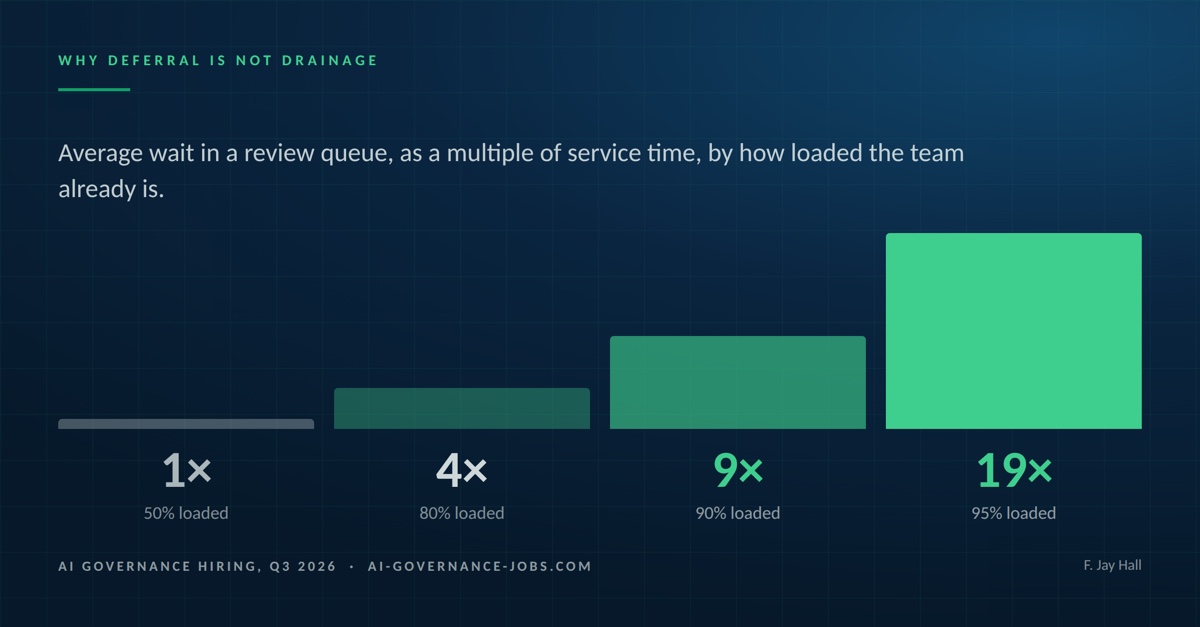
This is why I read the deferral as a trap rather than a gift. The Omnibus did not drain the queue. It removed the forcing function that was making organizations fund reviewers to clear it. If arrivals keep rising, as the Gartner forecast suggests, the queue fills regardless of what Brussels does with a date.
Little's Law links the counts to the times. The average number of systems anywhere in your governance process equals the arrival rate multiplied by the average time each one spends there, waiting plus review (L = λW). Count only the systems still waiting and the same law uses the average wait instead (Lq = λWq). It does not say a backlog grows forever. A backlog grows persistently when systems arrive faster than the team completes them, and it shrinks only when completions outpace arrivals. In a simple constant-rate picture, a backlog of B systems takes B divided by the difference between completions and arrivals to clear. It is a rough illustration, and it does not set a staffing number.
Then comes the part people miss. You cannot buy throughput retroactively. An organization that reaches December 2027 with a deep backlog cannot clear it by hiring that November, because new reviewers take time to recruit and onboard, and because a deep queue drains slowly whenever completions only modestly exceed arrivals.
What our job board data shows
I run a job board in this category, so here is what it shows. On November 3, 2026, GRC Careers listed 1,040 open governance, risk and compliance roles, and 407 of them, 39 percent, showed a pay range.
Be careful with what that number can and cannot say. It counts listings captured by GRC Careers, so it moves with our coverage and with how we add and remove listings as well as with employer hiring. It is not an estimate of the whole AI governance labor market. What the listings are useful for is composition. Three things stand out.
Governance is being engineered, not just written. Current postings include a Senior Staff Software Engineer for AI Governance at OneTrust and a Senior Risk and Governance Engineer at AlphaSense. The build side of governance now has its own job titles.
Federal and federal-adjacent work shows up. On November 3, 56 of the 1,040 listings mentioned a security clearance, from Public Trust to TS/SCI. If you hold a clearance and framework fluency, you qualify for roles many candidates cannot fill.
Salary transparency is still the exception. About four in ten listings show a pay range. Many listings come from employers' own career sites, where pay disclosure follows local law and each company's practice.
About these numbers. They describe listings live on GRC Careers on November 3, 2026, read from the board's job index that day. "Shows a pay range" means the listing displays a salary figure. Counts change with our coverage, ingestion and duplicate removal as well as with employer activity, so they are not an estimate of the entire AI governance labor market. An earlier version of this article cited 978 roles on October 5 and 304 at the end of July; we could not reproduce those figures from a dated snapshot, so we removed them.
Browse the current set: AI governance jobs, AI audit, responsible AI, Chief AI Officer, or the full directory.
The constraint is skills, not headcount
The SANS and GIAC 2026 Cybersecurity Workforce Research Report, published in March 2026, drew on 947 respondents worldwide, 72 percent of them in security or InfoSec leadership roles. Sixty percent identified missing skills as the greater staffing concern, against 40 percent who identified insufficient headcount. The comparable split was 52/48 in 2025. These are cybersecurity findings. They do not measure AI governance hiring directly, but they point the same way.
Context from earlier years points the same direction. ISC2's 2024 Cybersecurity Workforce Study found 37 percent of respondents facing budget cuts, 38 percent facing hiring freezes and 25 percent facing layoffs in their cybersecurity teams, while ISC2 estimated the global workforce gap grew 19 percent that year. Those are 2024 results. Use them as background; they are not a current estimate of AI governance labor supply.
Adding reviewers helps only if they can do the work that is waiting. Generalist analysts can raise throughput by taking inventory updates, evidence gathering and other delegated work off your specialists, but they will not clear Annex III classifications on their own until they learn how. Plan hiring around the work that is actually in the queue.
What to measure instead of headcount
- Arrivals per week. How many AI systems, models, agents and vendor tools entered your environment and needed governance review? If you cannot answer that, you do not have a working AI inventory.
- Completions per week. How many reviews did the team finish? If arrivals run above completions week after week, the backlog is growing.
- Lead time and processing effort. Lead time, or elapsed review time, runs from intake to sign-off; measure the median and the 90th percentile. Track hands-on processing effort separately. A long lead time with little effort means work is waiting, not hard.
- Active versus waiting work. How many systems are being worked on and how many are waiting? As committed capacity approaches 100 percent, waiting tends to grow quickly; watch the trend rather than a single threshold.
- Age of waiting cases and rework. How long has the oldest system been waiting, and how many come back for rework? A queue that ages month over month has already told you the answer to the hiring question.
- Capability coverage, by framework. Not how many people you have. How many people can independently complete an Annex III classification, an ISO 42001 gap assessment, or a NIST AI RMF GOVERN mapping. Specialist coverage is usually thinner than anyone expects.
Those numbers turn a budget argument into an operating argument, and operating arguments survive contact with a CFO better than "the regulation says so," especially now that the regulation says so sixteen months later.
The hiring window, and the wall behind it
My read is that some requisitions that would have been urgent in Q3 slid into 2027 budgets. If that is right, competition for strong candidates is lighter now than it will be as December 2027 approaches. We cannot measure that directly, so treat it as a reason to look.
Three moves worth making inside it.
Hire the scarce capability, not the open headcount. A person who can independently run an Annex III classification can do more for your throughput than several who need close supervision, while generalists add capacity by taking delegated work off that person. Build the requisition around what the person can clear, not what the org chart has room for.
Use fractional or interim help to buy service rate without buying a permanent seat. Heidrick & Struggles reports a 151 percent increase in its own interim C-suite engagements since 2021 (2026 High-End Independent Talent Report). That figure covers Heidrick's own interim business and does not measure fractional AI governance demand. It does show how many organizations already buy senior leadership in part-time or interim form. For classification work that needs clearing now without a permanent executive seat, fractional or interim help is worth pricing. We keep a hub for fractional AI governance and GRC roles.
Convert adjacent talent instead of competing for scarce talent. Compliance, internal audit, privacy, and legal professionals already hold most of what the work requires. Framework fluency is learnable in months. Judgment is not. In my experience, hiring for judgment and training for frameworks is the strategy that scales best, and too few employers use it. If you are the person on that side of the trade, start with you are probably already qualified.
IBM's 2026 CEO Study, a survey of 2,000 CEOs and equivalent leaders across 33 geographies and 21 industries from February to April 2026, found 76 percent of surveyed organizations have a Chief AI Officer, up from 26 percent in 2025. That describes the organizations surveyed, not every employer. The seats are being created. The question is whether they get filled while competition is lighter or after the queue has already backed up.
December 2, 2027 is a compliance deadline for the relevant Annex III requirements, not a sensible date to begin building the capacity needed to meet them.
Where to go next
- Post a governance, risk, or compliance role, hand reviewed
- Free job description templates, including the Ethical AI Specialist and the full AI governance set
- Start here: move into AI governance
- Career roadmaps for 17 roles and the complete AI governance guide
- Free certification practice questions across AIGP, ISO 42001, NIST AI RMF, CISM and more, no signup
- Certification comparison matrix at GRC-Careers.org
- Job alerts, new matching roles the moment they post
- AI governance news and the Insights series
Version française, édition québécoise, avec la Loi 25 et le cadre canadien : L’échéance a bougé. La file d’attente, non.
Sources
- Law: Regulation (EU) 2026/1744 (Digital Omnibus on AI), Official Journal July 24, 2026, in force July 27, 2026; European Commission AI Act implementation timeline
- Guidance (draft): European Commission, draft guidelines on the classification of high-risk AI systems, May 19, 2026
- Law: Texas HB 149 (TRAIGA), enrolled text, effective January 1, 2026; California SB 53, Chapter 138, Statutes of 2025; California AB 2013; Colorado SB 26-189, signed May 14, 2026; New York RAISE Act chapter amendment (S8828), effective January 1, 2027; Illinois SB 315, Public Act 104-0538, effective January 1, 2027
- Executive action: White House fact sheet on the December 11, 2025 executive order; Attorney General memorandum establishing the AI Litigation Task Force, January 9, 2026; National AI Legislative Framework, March 20, 2026 (nonbinding)
- Litigation: Justice Department intervention in the xAI challenge to Colorado SB 24-205, April 24, 2026
- Forecast: Gartner press release, August 26, 2025
- Survey: SANS Institute and GIAC, 2026 Cybersecurity Workforce Research Report, March 2026, 947 respondents
- Survey (2024): ISC2 2024 Cybersecurity Workforce Study, first look, September 11, 2024
- Survey: IBM CEO Study, May 4, 2026, 2,000 CEOs and equivalent leaders
- Firm data: Heidrick & Struggles, 2026 High-End Independent Talent Report (its own interim engagements)
- Model: Elementary queuing theory notes (M/M/1, Little's result)
- First-party: GRC Careers job index, November 3, 2026
Frequently Asked Questions
Did the Digital Omnibus delay the whole EU AI Act?
No. Regulation (EU) 2026/1744 moved the high-risk dates: Annex III standalone high-risk systems to December 2, 2027 and Annex I embedded systems to August 2, 2028. The Article 5 prohibited practices from February 2025, the general-purpose AI model obligations from August 2025 and the Article 50 transparency rules from August 2, 2026 still apply. The Omnibus also softened the AI literacy duty in Article 4, so providers and deployers now take measures to support AI literacy rather than ensure a sufficient level, and it added two prohibitions that start applying on December 2, 2026.
What AI Act deadline lands next?
December 2, 2026. Certain providers of systems placed on the market before August 2, 2026 that generate synthetic content have to meet Article 50(2) by then, and the prohibitions the Omnibus added on AI systems that generate non-consensual intimate material and child sexual abuse material start applying on the same date.
Should we delay AI governance hiring until 2027?
Not solely because one deadline moved. Base the decision on the duties that apply to your organization, how many AI systems arrive for review, how old your backlog is, and how much specialist capacity you have. A backlog grows whenever arrivals outpace completions, and new reviewers take time to recruit and onboard, so waiting until late 2027 makes the backlog harder to clear.
What should we measure instead of headcount?
Arrivals and completions per week, lead time from intake to sign-off at the median and 90th percentile, hands-on processing effort, active versus waiting work, the age of waiting cases, rework, and capability coverage by framework, meaning how many people can independently complete an Annex III classification, an ISO 42001 gap assessment or a NIST AI RMF GOVERN mapping.
Is the shortage about too few people or the wrong skills?
Mostly skills, at least in cybersecurity. In the SANS and GIAC 2026 Cybersecurity Workforce Research Report, 60 percent of the 947 respondents identified missing skills as the greater staffing concern, against 40 percent who identified insufficient headcount, compared with 52 and 48 percent in 2025. Those are cybersecurity findings, not a direct measure of AI governance hiring. Generalist analysts still add throughput when they take delegated work off specialists.
Who's Hiring AI Governance Professionals?
Explore current openings in:
AI Governance Jobs · Responsible AI · AI Risk · AI Compliance · AI Audit · AI Policy · Privacy · Cybersecurity · Public Policy
Search the latest opportunities at GRC Careers › · nonprofit GRC jobs ›