| Title | Compliance Manager |
|---|---|
| Department | Compliance / Legal & Regulatory Affairs |
| Reports to | [Director of Compliance / Chief Compliance Officer / General Counsel] |
| Scope | [Manages a team of N analysts / coordinates the program without direct reports]; [industry]; [jurisdictions]; [program size] |
| Location | [Remote / Hybrid / On-site] |
| Employment type | Full-time |
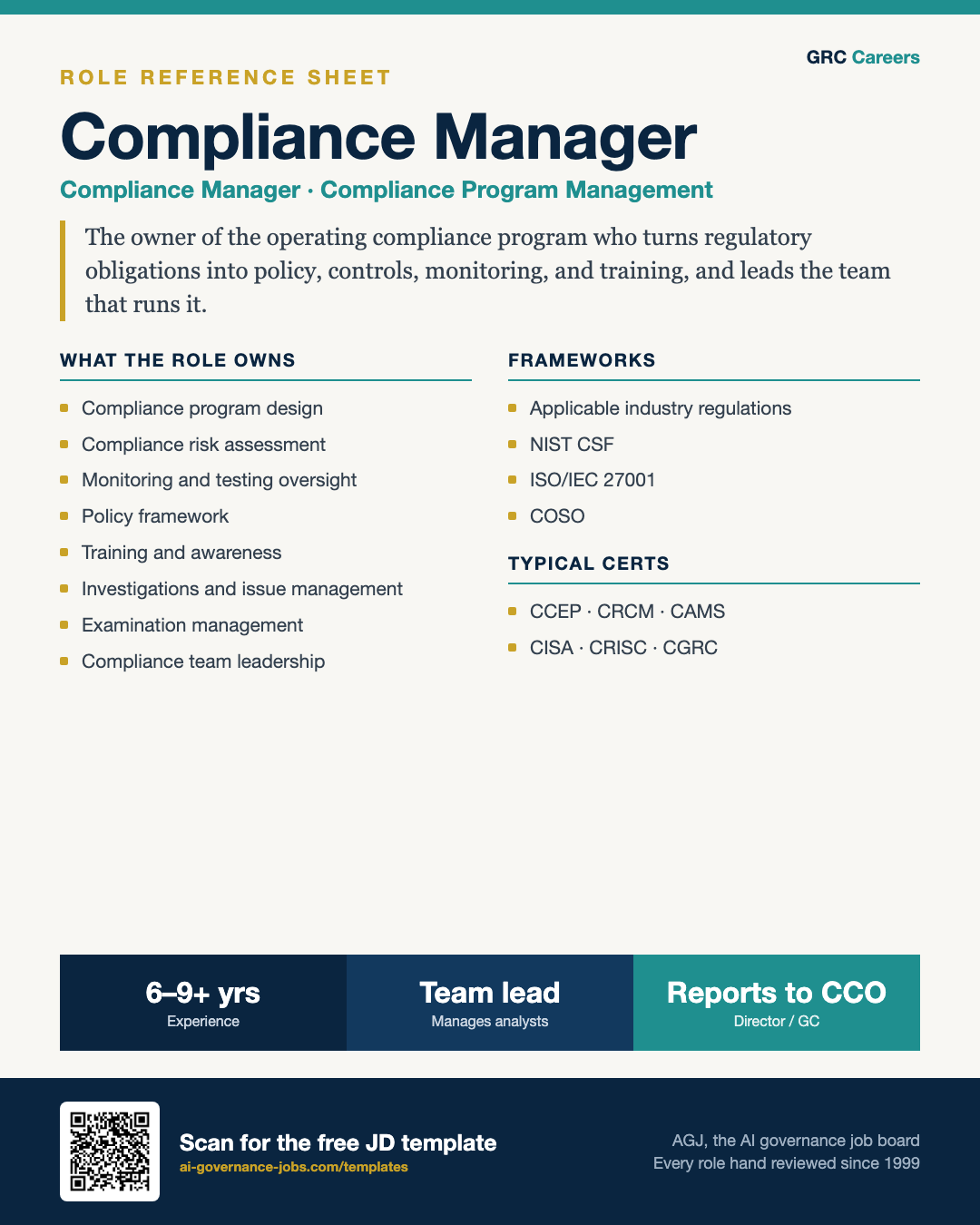
| Experience | [6 to 9+] years |
| Salary | [Pay range, currency and pay period, plus any bonus and material benefits. Check the pay-disclosure rules for each location where you post.] |
Position overview
The Compliance Manager leads the operating compliance program at [Company], translating regulatory obligations into practical policies, controls, monitoring, and training. The role owns day-to-day program execution and [manages a team of N compliance analysts and specialists / coordinates the program across business owners without direct reports].
The Compliance Manager partners with legal, risk, operations, and business leaders to set the compliance agenda, resolve issues, and prepare for examinations and audits. As regulators address AI and automated decision systems, this role builds those obligations into the program rather than treating them as an exception.
Choose the version that fits: a people-leading manager or a program coordinator without direct reports. Titles vary across organizations, so describe the scope you intend. Compared with a Regulatory Compliance Manager, this role covers the whole operating program rather than centering on regulatory change and examinations; a Director of Compliance or Chief Compliance Officer usually sets compliance strategy and reports to the board. Operational compliance stays distinct from legal advice, which comes from Legal, and from independent assurance, which comes from internal audit.
Key responsibilities
Program ownership
- Run the compliance program [as its owner / under the direction of the Chief Compliance Officer].
- Set the compliance calendar, priorities, and risk-based plan.
- Maintain the compliance risk assessment and program metrics.
- Report program status to senior leadership and committees.
Regulatory strategy
Turn regulatory obligations into an actionable program:
- Track regulatory change and assess business impact.
- Translate requirements into policies, controls, and procedures.
- Advise business leaders on regulatory implications of new initiatives.
- Build AI and automated-decision obligations into the program.
Monitoring and testing
- Oversee compliance monitoring and testing programs.
- Review findings, root causes, and remediation plans.
- Escalate significant issues and track them to closure.
- Strengthen controls based on testing results and trends.
Team leadership [if the role manages people]
Lead, coach, and develop compliance analysts and specialists, set clear priorities and standards, and manage workload across monitoring, policy, and investigation work.
Policy and training
- Own the policy framework and review cycle.
- Direct the compliance training and awareness program.
- Maintain approvals, exceptions, and attestations.
- Keep policies current with new laws and AI-related obligations.
Investigations and issue management
Oversee intake, investigation, and resolution of compliance issues, ensure corrective actions are effective, and manage regulatory reporting obligations, involving Legal where a matter needs legal advice.
Exams and audits
Serve as a primary point of contact for internal audits, external examinations, and regulatory requests, and coordinate evidence, responses, and remediation.
Required qualifications
- Bachelor's degree in Business, Finance, Law, Accounting, or a related field, or equivalent experience. Advanced degree or JD a plus.
- [6 to 9+] years of compliance, audit, or regulatory experience, including program or, if the role manages people, people leadership.
- Working knowledge of [the regulations that apply to your industry and jurisdictions].
- Experience owning compliance monitoring, testing, and policy programs.
- Track record managing examinations, audits, and regulatory relationships.
- Strong leadership, communication, and stakeholder-management skills.
Preferred certifications
One or more of: CCEP, CRCM, CAMS, CISA, CRISC, CGRC, depending on industry and program focus.
Technical knowledge
Compliance program management, regulatory strategy, compliance risk assessment, monitoring and testing oversight, policy governance, investigations, examination management, controls remediation, and AI and automated-decision compliance.
Essential competencies
People leadership, regulatory interpretation, risk-based decision making, stakeholder influence, executive communication, program management, and sound business judgment.
Success measures: first 12 months
- Establish or refresh the compliance risk assessment and program plan.
- Implement a risk-based monitoring and testing schedule.
- Strengthen the policy framework and review cycle.
- Stand up or improve compliance metrics and leadership reporting.
- Close priority remediation items and reduce open findings.
- Build AI and automated-decision obligations into the program.
- [If managing a team] Develop the compliance team's skills and coverage.
- Improve readiness for examinations and audits.
About [Company]
[Two or three sentences about your organization, the maturity of your program, and what the first year looks like. Candidates in this field respond to honesty about whether they are joining a build or an established function.]
Post this role on GRC Careers
Reach professionals who specialize in compliance program management rather than hoping they find you in a general feed. A person reviews every posting before it goes live, usually within one business day.
See how others are hiring
Review open GRC jobs to benchmark scope, level, and posted pay before you publish yours.
Stay close to the market
Job alerts
Get new GRC jobs sent to you as they post.
Newsletter
Hiring trends, salary signals, and new templates from GRC Careers.
Frequently asked questions
What does a Compliance Manager do?
A Compliance Manager runs the operating compliance program. They track obligations, run monitoring and testing, maintain policies and training, and manage investigations and examinations. Depending on the organization, they lead a team of compliance analysts or coordinate the program without direct reports.
What qualifications and certifications does a Compliance Manager need?
Most Compliance Managers have a bachelor's degree, sometimes a JD or advanced degree, and 6 to 9 or more years in compliance, including program or people leadership. Common certifications include CCEP, CRCM, CAMS, and CISA.
Who does a Compliance Manager report to?
A Compliance Manager typically reports to a Director of Compliance, the Chief Compliance Officer, or the General Counsel, depending on the size and structure of the organization. State the reporting line in the posting, because titles vary.
How is AI changing the Compliance Manager role?
Regulators are extending existing obligations to AI and automated decision systems. Compliance Managers increasingly build AI-related requirements, such as those in the EU AI Act and state AI laws, into monitoring, policy, and testing rather than treating them separately.