Home › AI Career Guides › Chief Technology Officer
Chief Technology Officer (CTO)
AI Engineering Edition
Building the technology that powers responsible AI: the technology vision, engineering, and architecture that bring trustworthy AI capabilities to life.
Artificial intelligence is reshaping how organizations innovate, compete, and deliver value. Behind every successful AI initiative is a technology foundation that is secure, scalable, and built for long-term success. Leading that effort is the Chief Technology Officer.
While the Chief Information Officer focuses on enterprise technology strategy and operations, the CTO is responsible for the technology vision, engineering, architecture, and innovation that bring AI capabilities to life.
Today's CTO plays a critical role in ensuring AI systems are not only powerful but also trustworthy, resilient, and aligned with responsible AI principles.
Why the Chief Technology Officer Matters
AI innovation requires more than powerful models. It demands thoughtful architecture, reliable engineering practices, scalable infrastructure, and technology decisions that support long-term business goals. The CTO leads the technical strategy that transforms AI ideas into production-ready solutions while ensuring those systems remain secure, ethical, and maintainable.
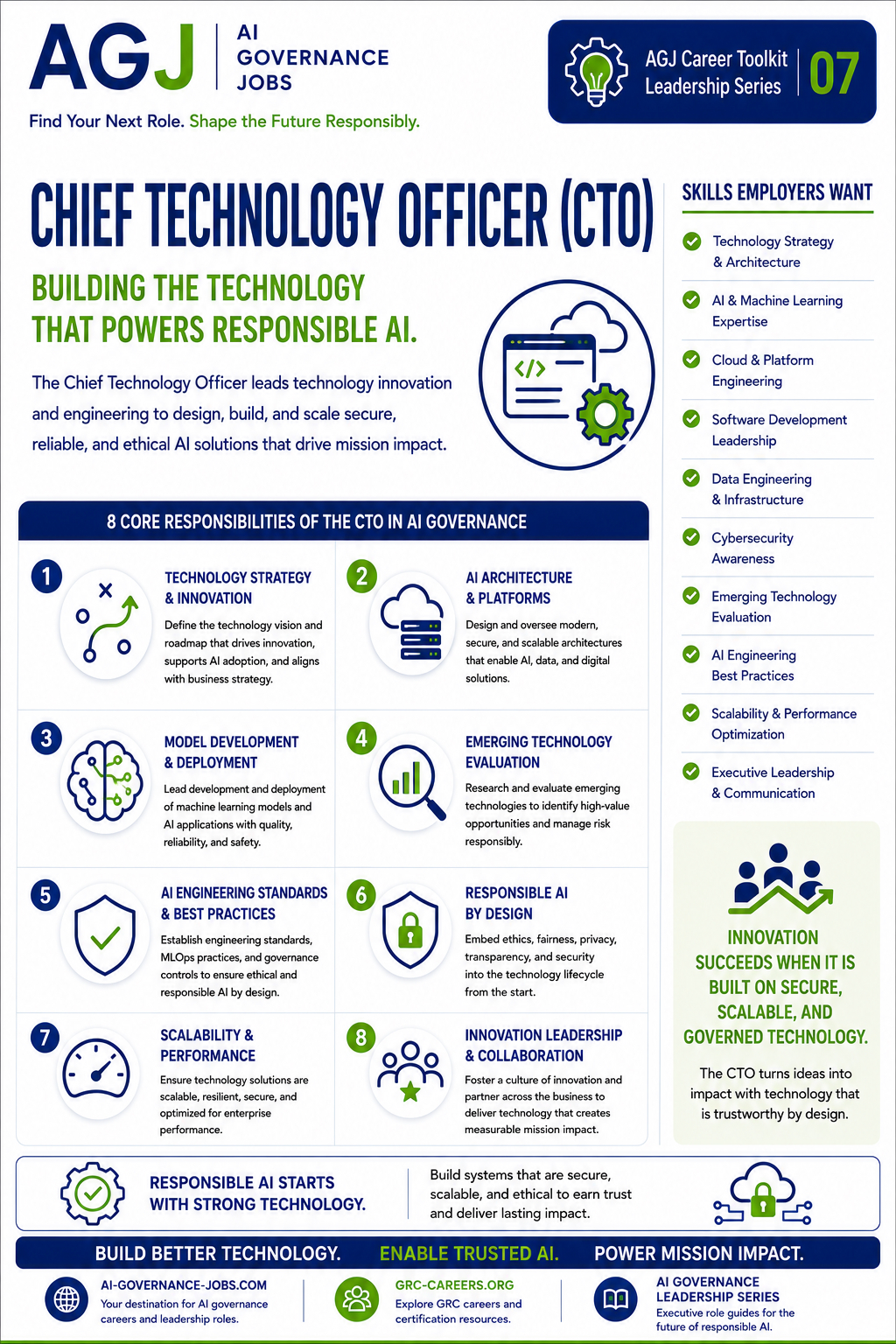
Eight Core Responsibilities
- Technology strategy and innovation. Develop the organization's long-term technology vision, ensuring innovation aligns with business strategy and AI objectives.
- AI architecture and platforms. Design secure, scalable technology platforms that support machine learning, generative AI, analytics, and future AI initiatives.
- Model development and deployment. Lead engineering teams responsible for building, testing, deploying, and maintaining production AI systems using modern development and MLOps practices.
- Emerging technology evaluation. Evaluate new technologies, AI platforms, and development frameworks while balancing innovation with operational risk and business value.
- AI engineering standards and best practices. Establish engineering standards, development frameworks, governance controls, and quality assurance processes that ensure reliable AI systems.
- Responsible AI by design. Embed security, privacy, fairness, transparency, and accountability into AI systems throughout the technology lifecycle instead of treating governance as an afterthought.
- Scalability and performance. Ensure AI solutions remain secure, resilient, highly available, and capable of supporting enterprise-scale workloads as adoption grows.
- Innovation leadership and collaboration. Partner with executive leadership, product teams, engineering, security, legal, compliance, and data leaders to deliver responsible AI innovation across the organization.
The CTO's Role in AI Governance
AI governance depends on strong technical leadership. The Chief Technology Officer helps organizations answer critical questions such as:
- Is our AI architecture scalable?
- Can our systems support enterprise AI securely?
- Are governance controls built into the technology?
- Can AI models be monitored and improved over time?
- Are engineering teams following responsible AI practices?
- Can our technology adapt as regulations evolve?
By addressing these challenges, the CTO enables organizations to innovate confidently while reducing technical debt, operational risk, and security concerns.
Skills Employers Are Looking For
Organizations hiring AI-focused CTOs increasingly seek leaders with expertise in:
- Technology strategy
- Enterprise architecture
- AI and machine learning
- Cloud engineering
- Software engineering leadership
- Data engineering
- MLOps and AI platforms
- Cybersecurity awareness
- Emerging technologies
- Executive leadership
- Cross-functional collaboration
- Innovation management
Recommended Certifications
Depending on industry and career goals, technology leaders often pursue certifications in cloud and platform engineering, machine learning, cybersecurity, enterprise architecture, and AI governance. Explore the certification roadmaps and learning paths at GRC-Careers.org.
Explore current Chief Technology Officer and AI engineering leadership positions on AI-Governance-Jobs.com.
Browse Chief Technology Officer jobs →The Future of the CTO
As artificial intelligence becomes embedded across every industry, the CTO will play an increasingly important role in shaping how organizations build, deploy, and govern AI technologies. Tomorrow's CTO must balance rapid innovation with responsible engineering, ensuring AI systems remain secure, scalable, transparent, and aligned with organizational values. The organizations that lead the next generation of AI will be those where technology leadership works hand in hand with governance, security, privacy, compliance, and business strategy to create AI systems people can trust.
AI Career Resources
Downloadable tools to help you prepare and advance. More are added to the library over time.
- Chief Technology Officers
- VPs of Engineering
- Heads of AI and machine learning
- Platform and cloud architects
- Engineering directors
- Technology and data leaders
- Executive recruiters
- Professionals pursuing AI governance leadership
Related AI Governance Essentials
Chief Technology Officers should also understand these foundational governance topics:
- AGE-001 — What Is an AI Inventory?
- AGE-002 — AI Use Policy
- AGE-003 — AI Risk Assessment
- AGE-004 — AI Risk Register (coming soon)
- AGE-005 — AI Governance Committee (coming soon)
- Browse the full AI Governance Essentials series →
Related AI Career Guides
- ACG-001 — Chief Information Security Officer: AI Security Edition
- ACG-002 — Chief Compliance Officer: AI Compliance Edition
- ACG-003 — Chief Risk Officer: AI Risk Edition
- ACG-004 — Chief Data Officer: Data Leadership Edition
- ACG-005 — Chief Privacy Officer: AI Privacy Edition
- ACG-006 — Chief Information Officer: Technology Leadership Edition
- Browse all AI Career Guides →
The AI Career Guides (ACG) series explores how artificial intelligence is reshaping executive leadership roles across governance, risk, compliance, cybersecurity, audit, privacy, data, and technology. Each guide combines practical career insight with related AI governance resources to help professionals prepare for the future of executive leadership.